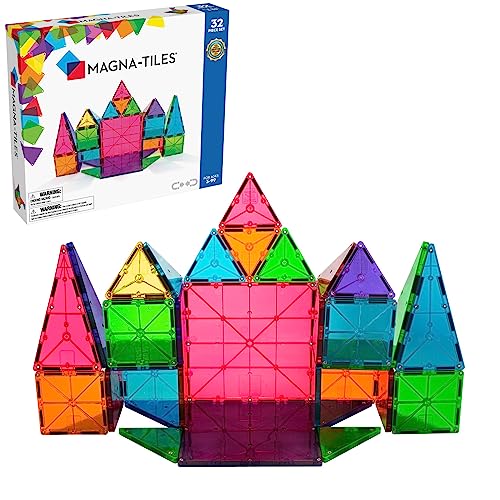
Original MAGNA-TILES 32-Piece Magnetic Construction Set - Educational
Original MAGNA-TILES 32-Piece Magnetic Construction Set - Educational Magnetic Building Blocks for Stimulating Creativity and Critical Thinking
Product information
$42.95
Product Review Score
4.35 out of 5 stars
53 reviewsProduct links
Educational toys play a crucial role in shaping the cognitive development of children. These toys are specifically designed to stimulate intellectual growth and help children learn new skills in a fun and interactive way. By engaging with educational toys, children are able to improve their problem-solving abilities, critical thinking skills, and creativity.
One of the key benefits of educational toys is that they encourage children to think outside the box. For example, puzzles and building blocks can help children develop spatial awareness and enhance their problem-solving skills. By figuring out how different pieces fit together, children are able to improve their analytical thinking and logical reasoning abilities.
Moreover, educational toys can also promote creativity and imagination in children. Toys such as art supplies and musical instruments allow children to express themselves in unique ways, fostering their imaginative thinking. By exploring different colors, shapes, and sounds, children are able to enhance their creative skills and develop a deeper appreciation for the arts.
Overall, the impact of educational toys on cognitive development is significant. These toys not only help children learn new skills, but also encourage them to think critically, creatively, and independently. By incorporating educational toys into playtime, parents and educators can support children's intellectual growth and help them reach their full potential.
Building Social Skills Through Playtime
Playing with toys is not just a fun way for children to pass the time - it also plays a crucial role in developing their social skills. When children engage in playtime with others, they are able to learn important concepts such as sharing, taking turns, and cooperation. These skills are essential for building strong relationships with others and navigating social situations in the future.
Toys provide a context for children to practice essential social skills in a safe and controlled environment. For example, playing with dolls or action figures allows children to act out different scenarios and practice empathy and communication. Board games teach children how to follow rules, take turns, and work together as a team towards a common goal. By engaging in these types of play, children develop important social competencies that they will carry with them into adulthood.
Furthermore, playtime with toys allows children to learn how to resolve conflicts and negotiate with others. When children play together, disagreements are inevitable. However, through these interactions, children learn how to communicate effectively, listen to others' perspectives, and find solutions that satisfy everyone involved. This is a valuable skill that will benefit children throughout their lives as they navigate relationships and workplace dynamics.
Role of Imaginative Play in Problem-Solving Abilities
Imaginative play, also known as pretend play, is a crucial aspect of a child's development that has a significant impact on their problem-solving abilities. Through engaging in imaginative play, children are able to explore different scenarios, experiment with various solutions, and think creatively to overcome obstacles. This type of play allows children to use their imagination to create new worlds, characters, and storylines, enabling them to think outside the box and come up with innovative solutions to problems they encounter.
One of the key benefits of imaginative play is that it helps children develop their cognitive skills. By pretending to be someone else or in a different situation, children are able to practice perspective-taking and empathy, which are essential skills for problem-solving. Through imaginative play, children learn to see things from different points of view, which can help them come up with more creative and effective solutions to problems.
Furthermore, imaginative play also helps children build their social skills, such as communication, cooperation, and negotiation. When children engage in pretend play with others, they have to work together to create and follow the rules of the imaginary world they have created. This collaborative aspect of imaginative play teaches children how to work with others to achieve a common goal, which is a valuable skill for problem-solving in real-world situations. By allowing children to use their imagination and creativity in play, toys play an important role in shaping children's minds and helping them develop essential problem-solving abilities.
Importance of Hands-On Learning for Young Minds
Hands-on learning plays a crucial role in shaping young minds and fostering their development. Through interactive play experiences with toys, children engage in sensory exploration and cognitive stimulation, helping them to better understand and internalize new concepts. For example, building blocks can enhance spatial reasoning and problem-solving skills, while puzzles can improve logical thinking and fine motor skills. By physically manipulating objects, children are able to make real-world connections and apply their knowledge in a meaningful way.
Furthermore, hands-on learning promotes creativity and imagination in young children. When given the opportunity to experiment and explore through play, kids are able to think outside the box and come up with innovative solutions to challenges. This type of open-ended play allows children to express themselves freely and develop their unique interests and talents. Whether it's crafting with art supplies or acting out role-playing scenarios with dolls, hands-on activities provide a platform for self-expression and self-discovery.
In addition, hands-on learning encourages social and emotional development in children. Playing with toys in a group setting fosters cooperation, communication, and empathy, as children learn to navigate social interactions and build positive relationships with their peers. Through shared play experiences, children develop important social skills such as taking turns, sharing, and problem-solving collaboratively. This not only strengthens their interpersonal abilities but also instills a sense of camaraderie and teamwork from a young age.
